
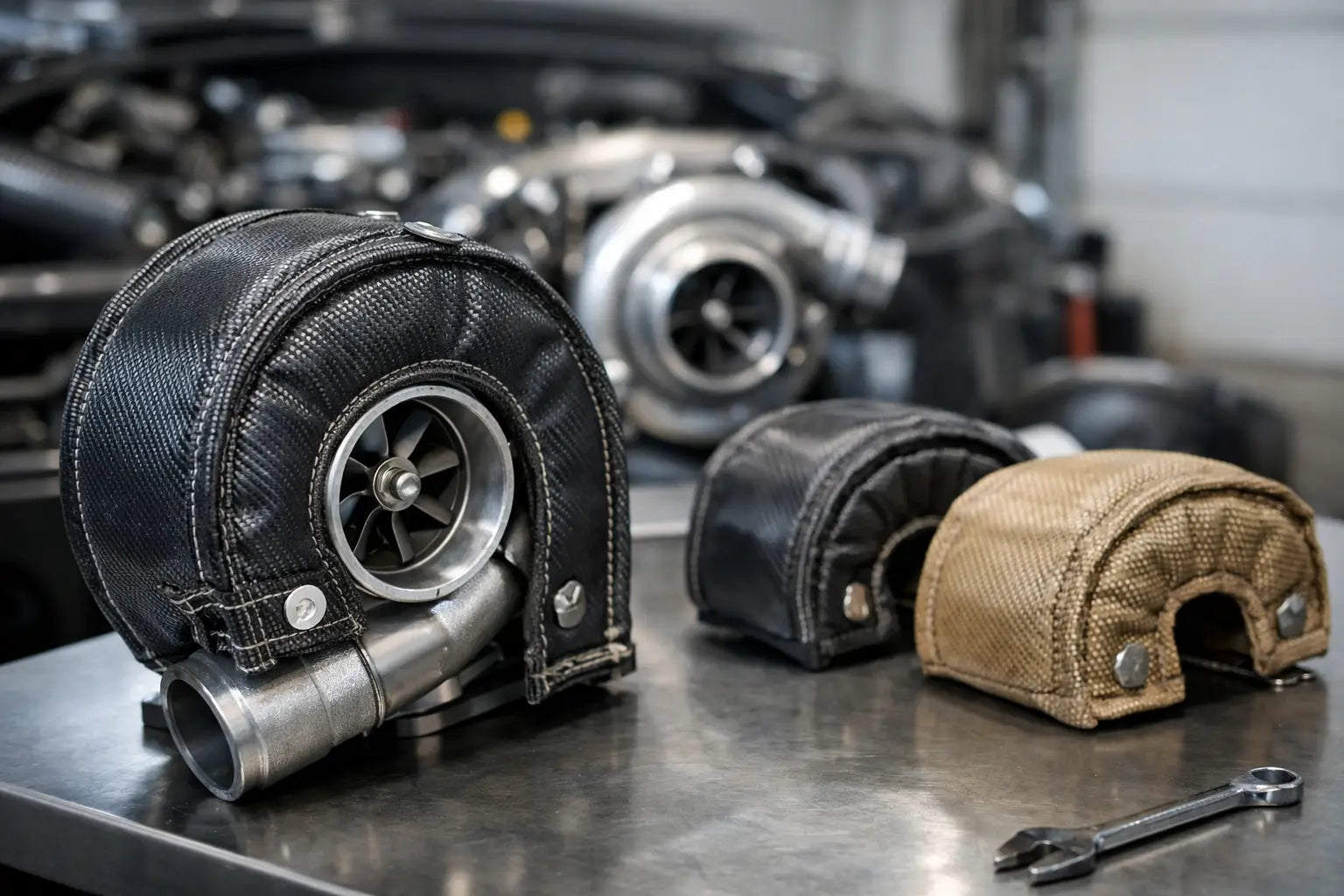
A turbo blanket is one of those upgrades that looks simple until you try to fit one around a tight, high-heat engine bay. Knowing how to choose a turbo blanket properly means looking beyond the logo, colour and claimed temperature figure. The right blanket needs to match your turbocharger’s turbine housing, your surrounding hardware and the way you actually use the car.
On a hard-driven road car, it can help reduce radiant heat around intake pipework, wiring, hoses and brake components. On a track or race build, it becomes part of a wider heat-management package that needs to survive repeated full-load runs. Buy the wrong size or use it carelessly, and you can create clearance problems, trap moisture or shorten the life of components you were trying to protect.
Start with the turbine housing, not the vehicle
Turbo blankets wrap the hot turbine side of the turbocharger, not the compressor housing. That sounds obvious, but vehicle-specific listings can make buyers assume every blanket is a direct fit. In reality, most are shaped around common turbine housing sizes and frame families.
Before ordering, identify the turbocharger model and turbine housing dimensions. A blanket designed for a compact internal-wastegate turbo will not necessarily sit correctly on a larger external-wastegate housing, even if both are fitted to the same engine. The key areas are the housing’s outside diameter, the width of the turbine section, the position of the actuator and the orientation of the wastegate or V-band outlet.
If your turbo has a known frame size, such as a Garrett GT28, GTX30, G25, GT35, BorgWarner EFR or Precision unit, use that as your starting point. Then check the manufacturer’s dimensions rather than relying on a frame name alone. Housings vary between A/R options and turbine configurations.
A blanket should cover the main turbine housing closely without being stretched hard across sharp edges or hanging loose around it. Too tight, and the fastening wire or springs can be difficult to secure and the material may be under constant strain. Too loose, and it can shift, rub on surrounding parts and leave major areas exposed to radiant heat.
Check clearance around the whole hot side
A turbo blanket does not make the turbo cool. Its job is to contain a large part of the radiant heat, so clearance still matters. Check what sits around the turbine housing before choosing a bulky blanket, particularly on transverse four-cylinder engines and compact turbo conversions.
Look closely at the actuator, boost control lines, oil feed and drain lines, coolant pipes, downpipe, driveshafts, steering rack, bulkhead and wiring loom. A well-fitted blanket can reduce heat exposure to these parts, but it must not press against them or force a hose into an awkward position.
External wastegate setups need special attention. The wastegate, screamer pipe and manifold collectors all generate serious heat, and a standard turbo blanket may not cover the areas causing the real problem. You may need a combination of turbo blanket, wastegate cover, heat shielding and properly routed lines rather than expecting one wrap to solve the entire bay.
Also inspect access. If you regularly check an oil feed fitting, remove an O2 sensor or adjust the actuator, choose a design that can be removed and refitted without dismantling half the exhaust side. A blanket that fits brilliantly but turns basic servicing into a fight is not the right product for a frequently used track car.
Choose materials for your temperature and use case
Most quality turbo blankets use a heat-resistant outer layer, an insulating middle layer and a woven inner layer designed to sit against the turbine housing. Basalt, silica, fibreglass and stainless-steel mesh are common materials, with each construction balancing heat resistance, durability, flexibility and price.
For a mildly tuned road car, a well-made blanket from a recognised performance brand is usually the sensible choice. The priorities are reliable fitment, secure fasteners and materials that tolerate regular heat cycles without fraying or breaking down.
For sustained track use, drifting, hillclimbs or race applications, look for a higher continuous temperature rating and more substantial stitching or wire reinforcement. Exhaust gas temperature, turbine housing temperature and under-bonnet airflow can all be far harsher after several consecutive laps than during a short road pull. A cheap universal blanket may survive a few heat cycles, then discolour, loosen or degrade where it contacts the housing.
Do not compare temperature claims in isolation. A headline maximum rating may refer to a short-term exposure limit, not the conditions the blanket can handle continuously. Construction quality matters just as much: reinforced seams, durable fastening hardware and close fit are what keep it in place when the engine bay is working hard.
Decide between a vehicle-specific and universal turbo blanket
A vehicle-specific blanket is usually the cleaner option where one is available for your factory turbo. It is shaped for the housing and accounts for common actuator and pipework positions, which reduces installation time and improves coverage. For owners of popular turbocharged BMW, Audi, Volkswagen, Honda, Toyota and Renault platforms, this can be the easiest route to a tidy result.
Universal blankets give more flexibility for aftermarket turbo kits, custom manifolds and unusual turbine housings. They are useful when the build has moved well beyond the original layout, but they demand more measuring and more patience during installation. Universal does not mean one size fits everything.
The trade-off is simple. A specific blanket generally offers better fitment certainty, while a universal design makes sense when your hardware is genuinely custom. If the product description only says it fits a broad range of turbochargers, compare its actual dimensions with your turbine housing before buying.
Make sure the fastening system suits the installation
Most turbo blankets are secured with locking wire, springs, hooks or integrated straps. This is not a cosmetic detail. The fastening system determines whether the blanket stays centred after vibration, heat cycling and repeated boost runs.
Wire-and-spring designs can provide a tight, secure fit, especially on round turbine housings. They can also be fiddly in a cramped engine bay. Integrated straps may be faster to fit, but need to be made from genuinely heat-resistant materials and positioned away from the hottest edges of the housing and downpipe.
Avoid forcing fasteners over actuator brackets, oil lines or sharp cast sections. If the blanket only fits by pulling it aggressively into place, reassess the size. It should sit securely, not look like it is one heat cycle away from tearing.
Think of the blanket as one part of heat management
A turbo blanket works best alongside sensible engine-bay planning. It can help keep intake temperatures more stable by reducing radiant heat into nearby pipework, but it cannot compensate for poor ducting, a badly placed open filter or an intercooler system that is already out of its depth.
Likewise, it is not a substitute for correct oil and coolant line routing. Keep hoses away from the turbine and downpipe, use appropriate heat sleeves where needed, and secure lines so they cannot migrate towards hot components under engine movement. On a serious build, a fabricated heat shield may still be the right answer for the master cylinder, alternator, wiring or bulkhead.
There is also a maintenance angle. By holding more heat around the turbine housing, a blanket can raise temperatures in that immediate area. Use quality oil, maintain the turbocharger properly and inspect the blanket periodically for chafing, loose fasteners, oil contamination and damaged stitching. Never fit one over an oil leak. Fix the leak first.
Installation checks before the first hard run
Once fitted, rotate the engine by hand if you have been working close to belts or accessories, then inspect every point around the turbo with a light. Confirm the blanket clears moving components, does not obstruct the wastegate actuator and is not pinching a line.
After the first heat cycle, let the car cool completely and check it again. Fasteners can settle as the material beds in. Look for signs of contact on the blanket, nearby hoses or wiring insulation. A quick inspection now is far cheaper than discovering a melted boost line at the next track day.
The best turbo blanket is not necessarily the thickest or the most expensive. It is the one that accurately fits your turbine housing, handles your engine’s heat load and leaves the rest of the installation safe and serviceable. Measure first, choose proven materials, and treat heat control as a complete build decision rather than a single add-on.