
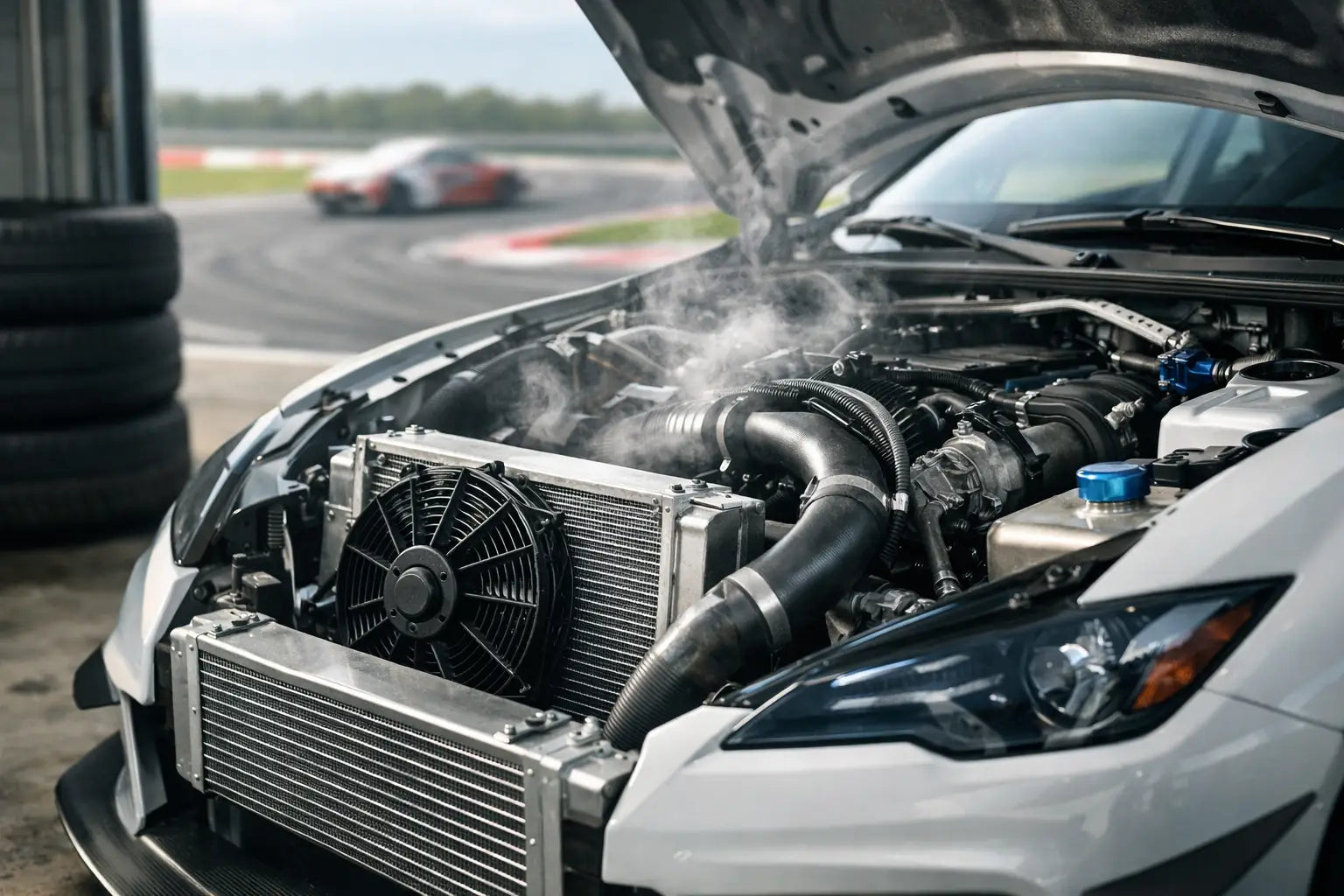
A car that runs perfectly on the road can start shedding power, pushing coolant, boiling brake fluid or limping home halfway through a track session. That is why a proper track car cooling guide starts with heat management as a system, not a single oversized radiator. More grip, more boost, stickier tyres and longer sessions all put extra thermal load into the car. If the cooling package cannot reject that heat consistently, the lap timer will eventually expose it.
The target is not the lowest possible temperature. It is stable, repeatable operating temperature across a full session, with enough headroom for a hot day, traffic in the pit lane and the odd clear lap when the engine is working at maximum load.
Start With Data, Not Parts
Before buying hardware, establish what is actually getting hot. A factory temperature gauge is often a poor diagnostic tool: many are deliberately damped, sitting in the middle of the scale across a surprisingly wide temperature range. Use the ECU data, a quality digital gauge or a logger to record coolant temperature, oil temperature, intake air temperature and, where possible, oil pressure.
Log a normal session rather than relying on one peak number. Does coolant temperature rise steadily every lap? Does oil temperature spike after a few hard corners? Do intake temperatures climb while boost pressure and ignition advance fall away? The pattern matters because it points to a different restriction.
Also check the basics before calling for upgrades. A tired radiator cap, incorrect coolant mix, blocked condenser fins, collapsing hose, weak water pump or air trapped in the system can imitate a much larger cooling problem. On older track platforms, especially modified turbo cars, a careful bleed procedure and a fresh cap can be as relevant as the shiny parts.
The Track Car Cooling Guide to Airflow
Radiator size matters, but airflow management matters just as much. A larger core with air bypassing around it is not using its full area. At speed, air will take the easiest route. If there are gaps between the radiator, fan shroud, bumper ducting and surrounding panels, high-pressure air can escape around the core rather than pass through it.
Seal the front of the cooling stack to the bumper opening where practical. Foam seals, side panels and properly fitted ducting can make a real difference, particularly on cars with large aftermarket front openings. Behind the radiator, create a clear low-pressure exit path. A tightly packed engine bay, undertray arrangement or bonnet with no extraction can trap hot air and reduce the pressure difference that pulls air through the core.
Bonnet vents can work extremely well, but placement is everything. They need to sit in a genuine low-pressure area and be backed by sensible ducting, not installed purely for appearance. They can also affect wet-weather use, engine-bay component life and road legality. For a car that does both track days and daily miles, a well-sealed radiator package may be the better first move.
Do not overlook the cooling stack. An intercooler, air-conditioning condenser, oil cooler and radiator all compete for the same airflow. A big front-mount intercooler can be essential on a boosted build, but it also warms the air reaching the radiator. The answer is not automatically to remove components. It is to choose correctly sized cores, mount them intelligently and manage the air path through the whole stack.
Coolant Temperature: Capacity and Control
Once airflow is working, assess radiator capacity. A quality aluminium radiator with an efficient core design can add useful thermal reserve over a worn factory unit, especially where the original plastic end tanks and narrow core were designed around commuting rather than repeated full-load running. Fitment is critical: a part that promises huge capacity but leaves poor fan clearance or creates awkward hose routing is not a track-ready solution.
Fans are most valuable at low speed. They help during queueing, pit-lane crawling and cool-down laps, but they cannot compensate for poor high-speed airflow. Confirm that the fan pulls air through the full radiator area, that the shroud seals well and that the ECU or switch strategy brings the fan in at an appropriate temperature.
A lower-temperature thermostat is not a universal fix. It may begin opening earlier, but it cannot solve insufficient radiator capacity, restricted airflow or combustion heat that the system cannot reject. If the thermostat is already fully open, the rest of the system still has to do the work. Use one only when it suits the engine’s operating strategy and the wider cooling package.
Coolant choice deserves a measured approach. The correct water and antifreeze ratio protects against corrosion and freezing, while additives may improve heat transfer in suitable applications. However, plain water-based mixtures are not appropriate for every climate or road car, and some track organisers have rules around glycol use. Check the event regulations and protect the system properly between events.
Oil Cooling Is Engine Protection
Engine oil is doing far more than lubricating bearings. It removes heat from pistons, turbocharger hardware and heavily loaded internal components. When oil gets too hot, viscosity falls, oxidation accelerates and oil pressure can suffer. Conversely, oil that never reaches proper working temperature can retain moisture and fuel contamination.
For a naturally aspirated car with modest power, fresh quality oil and a healthy factory heat exchanger may be enough. Add sustained high revs, turbocharging, forced induction upgrades or repeated summer sessions, and an external oil cooler often becomes a sensible reliability upgrade.
The installation is where good builds separate themselves from catalogue shopping. Use a thermostatic sandwich plate or thermostat-controlled arrangement so the oil reaches operating temperature before being sent through the cooler. Mount the cooler where it receives clean airflow without completely blocking the radiator. Choose lines, fittings and mounting brackets that can tolerate vibration, heat and pressure. A cheap hose failure can empty an engine faster than any temperature warning.
Watch oil pressure alongside oil temperature. A pressure drop as oil gets hot may point to oil grade, bearing condition, pickup control or an oiling-system issue, not merely a need for more cooling. Track driving can uncover oil surge during braking and cornering, so a baffled sump, upgraded pickup or accumulator may be more urgent than an extra row in the oil cooler.
Charge-Air Cooling and Heat Soak
Turbocharged engines face a second battle: intake air temperature. Hot charge air increases knock risk and encourages the ECU to pull ignition timing or reduce boost. The result is a car that feels sharp on lap two and flat by lap six, even if coolant temperature looks acceptable.
For front-mounted intercoolers, prioritise core efficiency, pressure drop and ducting over maximum frontal area. An unnecessarily thick intercooler can restrict radiator airflow and add lag without improving real session performance. A properly sized core with sealed end tanks and a clean path from bumper opening to core is usually the stronger track-day choice.
Cars with top-mounted intercoolers need disciplined bonnet-scoop sealing. If air can spill around the core, it will. Water-to-air systems can be highly effective, particularly where packaging is limited, but they introduce another coolant circuit, pump, heat exchanger and potential failure point. They are excellent when engineered as a package, not when fitted as a shortcut.
Brake Cooling Keeps the Pedal There
Brake temperature is part of the same conversation. High-temperature pads and fluid help, but they are not magic if the discs are being cooked with no airflow. A firm pedal at the start of a session that goes long or inconsistent later can be fluid boil, pad fade, overheating seals or excessive disc temperature.
A proper brake duct system feeds air from a high-pressure front opening to the centre of the disc, where the internal vanes can pump it outward. Blowing air at the disc face is less effective. Use heat-resistant hose, secure mounts and enough clearance for full steering lock and suspension travel. Inspect the system after every event because kerbs, tyre debris and track excursions are hard on ducting.
Brake cooling brings trade-offs. Ducts can be vulnerable, take up valuable bumper space and may not suit every road-driven car. But on heavier cars, high-grip builds and repeated hard braking circuits, it can extend pad, disc and fluid life while making braking performance more consistent.
Build in the Right Order
The most effective cooling builds solve the biggest restriction first. Service the system, log temperatures and pressure, then improve airflow and duct sealing before assuming every problem needs the largest available core. From there, choose platform-specific radiator, oil-cooler, intercooler and brake-duct components that fit the intended power level and use case.
Do not build only for the perfect 15-minute session in mild weather. Build for the hot afternoon, the back-to-back run group and the final lap where confidence in the pedal and oil pressure lets you keep driving properly. That is where a well-planned cooling package earns its place.