
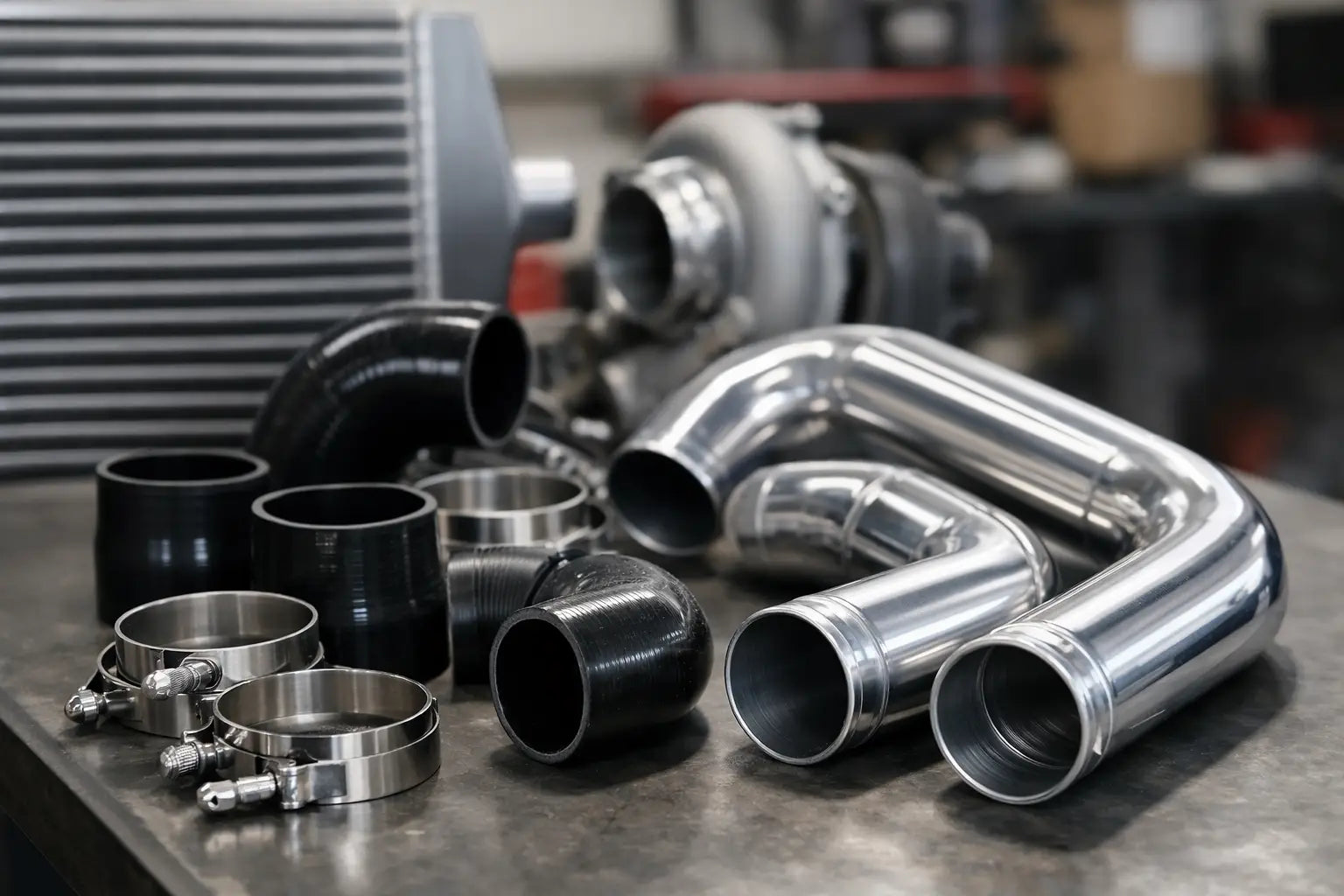
A front-mount intercooler can look spot-on behind the bumper yet still hold a build back if the pipework is poorly matched. Learning how to choose aftermarket intercooler piping means looking beyond polished aluminium and choosing a system that supports your turbo, power target, packaging and intended use. The right kit keeps charge-air temperatures under control, holds boost without leaks and leaves room for the rest of the build to work properly.
Start with the car, turbo and power target
Intercooler piping is not a universal upgrade where bigger automatically means better. A mildly tuned 1.8T, EP3 Type R or BMW N54 needs very different pipe sizing and routing from a big-turbo 2.0-litre track car. Before comparing kits, establish the turbocharger type, realistic horsepower target, intercooler core inlet and outlet sizes, throttle-body diameter, and whether the car retains the standard inlet manifold.
A vehicle-specific kit is normally the sensible starting point. It has been designed around the factory crash bar, radiator pack, air-conditioning hardware, engine movement and bumper clearance. That matters on modern platforms where even a small routing change can create contact with a fan shroud, headlamp bracket or undertray.
Universal piping is useful for custom turbo conversions, engine swaps and motorsport builds, but it comes with fabrication work. You may need to cut sections, bead pipe ends, make brackets and solve clearance issues that a platform-specific kit has already addressed. Buy universal parts because your build genuinely needs custom routing, not because the initial price looks lower.
Choose the right intercooler pipe diameter
Pipe diameter affects airflow speed, pressure drop and total charge-air volume. Oversized piping can slow transient response because the turbo has more volume to pressurise, while undersized piping can become restrictive as airflow demand rises. The aim is efficient flow for the actual engine, not the largest tube that will fit behind the bumper.
For many road and fast-road turbo four-cylinder builds, 57 mm or 2.25-inch piping is a proven, well-balanced choice. It offers good flow capacity without adding excessive volume. Around the 350 to 500 bhp mark, 63.5 mm or 2.5-inch piping is common, especially where the turbo and intercooler have suitably sized outlets. Larger 76 mm or 3-inch pipework is generally for high-output applications, larger-capacity engines or builds where packaging and turbo response have been considered as a complete system.
Do not judge pipe size in isolation. A 3-inch pipe connected to a 2.25-inch throttle body does not turn the entire system into a 3-inch flow path. Abrupt step-ups and step-downs can disturb flow, so use smooth, sensible transitions where components differ in size.
Keep the route efficient, not merely short
The shortest route is not always the best route. A pipe that sits hard against the radiator, crosses a sharp bracket edge or requires a tight silicone bend can create more problems than it solves. Aim for smooth bends, minimal unnecessary joins and proper clearance through the engine’s full movement range.
On a street car, the preferred route may retain fog lamps, air-conditioning and factory bumper structure. On a dedicated track build, a shorter or more direct route may be worthwhile if it improves access, reduces joins and works with the cooling package. The right answer depends on how the car is used.
Aluminium, stainless steel or mild steel?
Aluminium is the go-to material for most aftermarket intercooler piping. It is light, corrosion-resistant and readily available in a wide range of diameters, bends and finishes. A properly made aluminium kit keeps weight off the nose of the car, which is particularly welcome on front-heavy turbo platforms.
Stainless steel is exceptionally durable but heavier and usually more expensive. It can make sense where a custom fabricator is producing complex, high-strength sections, but it is rarely necessary for a conventional road or track-day intercooler setup. Mild steel is inexpensive and easy to fabricate, although it needs quality coating or paint to resist corrosion. It is more at home in budget custom projects than in a clean long-term installation.
Pipe wall thickness matters too. Thin-wall aluminium saves weight but can be easier to deform if unsupported or clamped poorly. Excessively thick pipe adds weight with little benefit. For most performance builds, quality aluminium tubing with well-formed bends and securely beaded ends is the sweet spot.
How to choose aftermarket intercooler piping that stays sealed
Boost leaks turn a promising parts list into a frustrating fault-finding session. A leak can cause slow spool, inconsistent boost, rich or lean running depending on the engine management strategy, and a noticeable loss of power. The pipe itself matters, but the couplers, clamps and mounting strategy matter just as much.
Look for rolled or beaded pipe ends. The bead gives the silicone coupler something to grip and significantly reduces the chance of a hose blowing off under boost. A plain-cut pipe can work in a low-pressure setup, but it is a weak point on a hard-used turbo car unless it has been properly beaded.
Multi-ply silicone couplers are preferable to cheap thin rubber items. They cope better with heat, oil vapour and repeated pressure cycles. Straight couplers are simple, while hump couplers are useful where the engine moves relative to the intercooler or fixed pipework. That extra flexibility can prevent a rigid system from pushing itself apart under load.
Clamps deserve proper attention. Quality T-bolt clamps offer even clamping force and are a strong choice for higher-boost applications. Traditional worm-drive clamps can work on low-pressure systems, but their narrow band and uneven loading make them less confidence-inspiring on tuned cars. Tighten clamps evenly, recheck them after heat cycles, and never overtighten them to disguise poor fitment.
Check sensor, valve and breather provisions
Modern forced-induction engines often have more hardware in the charge path than owners expect. Depending on the platform, your piping may need provisions for a MAP sensor, intake air temperature sensor, diverter valve return, dump valve, crankcase breather connection or water-methanol injection. A kit that fits physically but omits a required port is not a complete solution.
Check whether factory sensors transfer directly, whether an adaptor is supplied, and whether the sensor position maintains the original measurement strategy. A badly positioned sensor or an improvised weld-in boss can create drivability problems that are harder to diagnose than a simple mechanical fitment issue.
If you are planning a later upgrade such as a larger turbo, external wastegate conversion or water-meth kit, consider whether the chosen piping gives you a clean path to add those components. Future-proofing is sensible when it does not compromise today’s fitment.
Prioritise fitment over a universal bargain
A cheap kit with vague vehicle compatibility can quickly become expensive. Poorly aligned pipes place load on couplers, rub through against bodywork, interfere with cooling fans or force you to trim bumper components more aggressively than expected. Even worse, a kit may technically fit but leave no access for servicing headlights, radiator hoses or the oil filter.
Check the exact chassis, engine code, turbo configuration and drive orientation before ordering. This is especially relevant for cars with multiple factory intercooler layouts, facelift changes or aftermarket turbo manifolds. A kit designed for a standard-location turbo may not work with a rotated compressor housing or a tubular manifold setup.
Review the full contents of the package. A proper kit should make clear whether it includes pipes, silicone couplers, clamps, brackets, sensor fittings and any required hardware. If it is sold as pipework only, budget for the supporting parts rather than assuming your existing clamps and hoses will work.
Match the finish to the job
Polished pipework looks great at a meet or with an open engine bay, but it will not add power over a well-made black or raw aluminium system. Powder-coated black piping can suit understated OEM-plus builds and may hide road grime better. Raw aluminium has a purposeful motorsport look and is easy to inspect for rubbing, oil residue or damage.
Make the decision based on the engine bay you are building and the maintenance you are prepared to do. Function comes first, particularly on a car that sees track kerbs, heat cycles and regular hard use.
Install it like a performance component
Before final tightening, test-fit every section with the bumper and undertrays considered. Make sure pipes clear sharp edges, moving pulleys, hot exhaust components and the bonnet. Use brackets where needed rather than asking a silicone coupler to carry the weight of a long pipe section.
Once fitted, pressure-test the intake system. This is one of the quickest ways to find leaks before they become a tuning or reliability issue. After the first few drives, inspect for coupler migration, clamp witness marks and contact points. A small adjustment now is far better than discovering a split hose during a full-boost pull.
Choose piping as part of a complete charge-cooling package, not as an afterthought. When diameter, routing, couplers and fitment all match the build, the result is cleaner response, dependable boost and a setup you can lean on every time the road opens up. If you are comparing options, Torque Lab’s vehicle- and brand-led approach helps keep the focus where it belongs: parts that fit the platform and support the target.