
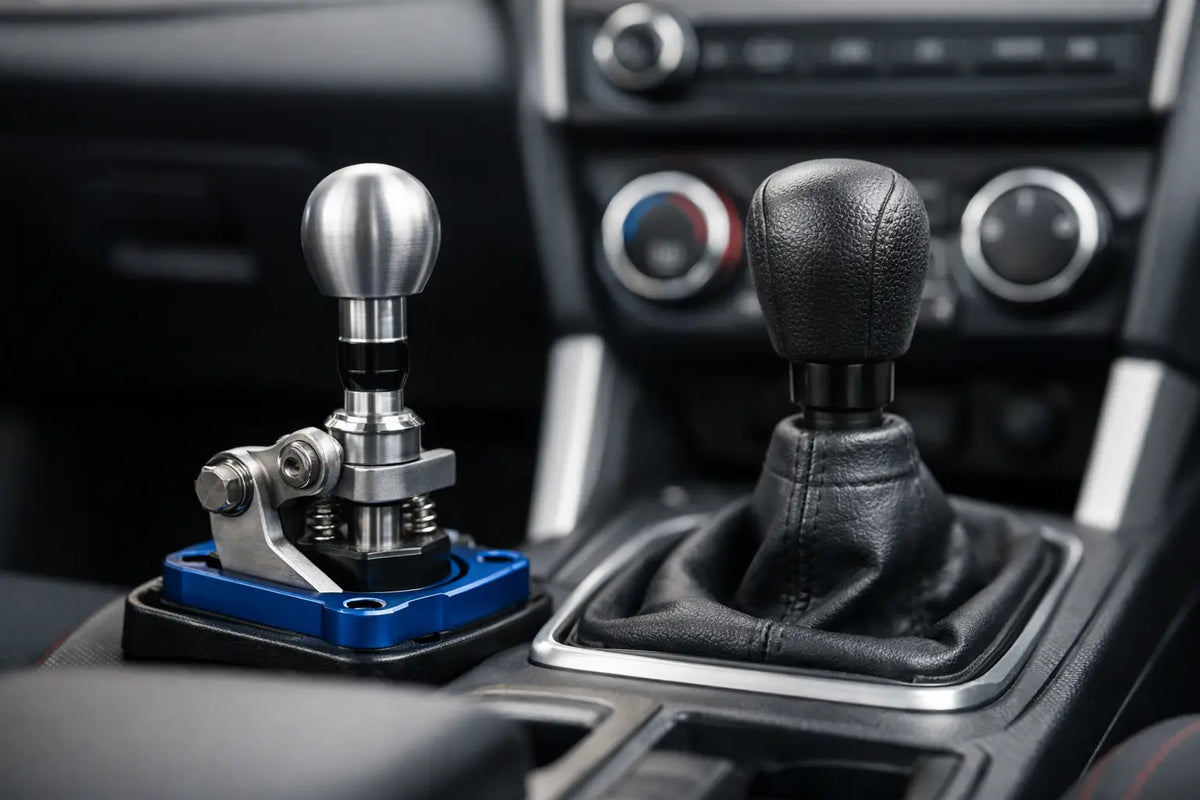
A manual gearbox can be mechanically perfect and still feel vague at your hand. That is why the short shifter vs stock shifter debate matters more than the usual “race-car feel” marketing suggests. Your gear lever is the part you interact with on every drive, whether you are heel-and-toeing into a hairpin, joining a motorway or just dealing with stop-start traffic.
A short shifter can make a familiar car feel sharper, faster and more connected. It can also make it heavier, notchier and less pleasant when the car is cold. The right answer depends on your platform, the quality of the kit and what you expect from the car.
Short shifter vs stock shifter: the real difference
A stock shifter is designed around broad usability. Manufacturers have to account for drivers with different strengths, driving habits and expectations, while also controlling noise, vibration and harshness. The result is usually a light, forgiving shift action with enough leverage to make gear selection easy, even when the gearbox oil is cold or the driver is not particularly precise.
A short shifter changes the geometry of that mechanism. Most kits reduce the distance the lever travels between gears, known as shift throw. Depending on the design, they may also shorten the lever height, alter the pivot point, replace compliant bushes, or use a more rigid mounting arrangement.
The result is not necessarily a faster gearbox. The synchronisers inside the transmission still determine how quickly the next gear can be engaged safely. What changes is the time and hand movement needed to move the lever through the gate. A good short shifter makes the shift feel more deliberate, with a clearer sense of where each gear sits.
That distinction is worth keeping in mind. A short shifter improves the driver interface. It does not turn a tired gearbox, worn linkage or dragging clutch into a close-ratio sequential transmission.
What a stock shifter still does well
There is a reason many factory shifters remain in place on seriously capable road cars. A standard setup generally offers more leverage, which means lighter effort. It also gives the driver more physical feedback through a longer movement. For daily driving, that can make first-to-second shifts smoother and reverse easier to select without thinking about it.
The factory shifter also tends to work well with the rest of the car’s isolation. Soft linkage bushes and damped mechanisms reduce gearbox vibration at the knob. That matters in a refined BMW, Audi, Volkswagen or Honda that spends most of its life on public roads.
A stock shifter is often the better choice when the car is a commuter, shared with less enthusiastic drivers, or already has a gearbox that can feel reluctant when cold. If the shift action is loose because of worn cable ends, selector bushes or engine mounts, restoring those components may deliver a bigger improvement than fitting a short shifter immediately.
There is also the question of calibration. On many modern manual platforms, the original mechanism is genuinely good. Chasing the shortest possible throw can sacrifice the smoothness that made the factory arrangement enjoyable in the first place.
Why enthusiasts fit short shifters
The strongest case for a short shifter is driver confidence. When the gate is tighter and the lever has less wasted movement, quick shifts become easier to repeat. That is useful on track, during spirited road driving and in any car where the original linkage feels long, rubbery or disconnected.
A well-engineered kit can improve several parts of the experience at once. The throw is shorter, lateral movement can feel more defined, and firmer bushes remove some of the delay between your hand moving and the transmission selector responding. On cable-shifted cars in particular, upgraded cable bushes or bracket bushes can make a noticeable difference without making the car unbearable.
For a track-day build, the benefit is less about chasing milliseconds and more about consistency. You are braking hard, steering, managing weight transfer and selecting the next gear in a compressed window. A positive gate helps reduce the chance of an indecisive shift or a missed third when you need it most.
Short shifters also suit cars with a naturally long factory throw. Many older Japanese and European performance platforms respond brilliantly because the standard mechanism leaves plenty of room for improvement. A shorter, more mechanical action can make the whole cabin feel closer to the car’s purpose.
Short throw does not always mean better feel
The aggressive kits are not automatically the best kits. Reducing throw dramatically usually reduces leverage too, so shift effort rises. A 40 or 50 per cent throw reduction may sound appealing, but it can make the gearbox feel awkward in town and encourage drivers to force shifts before the synchronisers are ready.
For many road-and-track cars, a moderate reduction delivers the best result. You get a more compact shift pattern without turning every second-gear change into a gym session. The quality of the pivot assembly, fitment accuracy and bush material matter more than the biggest percentage claim on the box.
The trade-offs: effort, noise and gearbox wear
A short shifter should make you more precise, not more aggressive. If a setup makes you slam the lever through the gate, it is working against the transmission. The shift linkage may be capable of moving faster, but the internal gearbox components still need time to synchronise shaft speeds.
Increased effort is the most common trade-off. It can be mild with a quality street-focused kit or substantial with a tall-pivot, race-oriented assembly. Some drivers love the heavy, mechanical feel. Others find it tiring on longer journeys, particularly in traffic.
Noise, vibration and harshness can increase too. Solid mounts, metal bushes and rigid base plates transmit more drivetrain movement into the cabin. That may add a satisfying mechanical buzz in a stripped-out track car, but it can be intrusive in a daily-driven hot hatch or executive saloon.
Installation can create problems when it is rushed. Cable adjustment needs to be exact, retaining clips must be secure, and interior trim clearance should be checked throughout the full range of movement. A shifter that contacts the console, has poorly adjusted cables or uses low-grade hardware can feel worse than a healthy stock unit.
Finally, avoid treating a short shifter as a fix for mechanical faults. Crunching gears, popping out of gear, difficulty selecting gears with the clutch depressed, or excess play in the lever deserve diagnosis first. Check the clutch hydraulic system, linkage condition, transmission mounts and gearbox oil before adding performance parts.
Choosing the right setup for your car
Start with how the car is actually used. A weekend B-road car with occasional track days can benefit from a moderate short shifter, fresh bushes and a quality weighted gear knob. That combination often delivers a more direct shift without excessive effort.
A dedicated circuit car can justify a more serious solution. A rigid shifter assembly, firmer cable hardware and a taller lever may give the positive engagement needed when wearing gloves or driving hard for extended sessions. Cabin refinement is rarely the priority in that build.
For a daily driver, favour a platform-specific kit from a proven manufacturer rather than a generic universal design. The best options are engineered around the factory cable travel, tunnel dimensions and reverse-lockout system. They should include clear fitting hardware and retain reliable gear selection across the full gate.
It is also worth considering the upgrades around the shifter. A worn gearbox mount can make the drivetrain move as you change gear. Old selector bushes can create the slack you are trying to remove. A weighted knob can add momentum to the shift, while a very heavy knob may mask the feedback needed for clean, sympathetic changes. Build the system around the character you want rather than buying parts at random.
Torque Lab customers often shop by platform because fitment is not a detail here - it is the difference between a satisfying upgrade and an afternoon spent modifying brackets that should have fitted first time. Confirm the transmission code, model year, drive configuration and whether the car uses cables, rods or a direct-mounted shifter before ordering.
Is a short shifter worth fitting?
For an enthusiast who enjoys the act of changing gear, usually yes. The improvement can be immediate: less reach, a cleaner gate and a stronger connection to the drivetrain. It is one of the few cabin upgrades that changes the character of every mile rather than only appearing on a specification sheet.
But it is worth fitting the right short shifter, not simply the shortest one available. Road cars benefit from balance. Track cars benefit from certainty. And any manual car benefits from a healthy clutch, correctly adjusted linkage and a driver willing to let the gearbox do its job.
If your factory shift feels long but smooth, choose a measured reduction and preserve that usability. If it feels vague, inspect the bushes and linkage before blaming the lever. Get those fundamentals right, then select a platform-specific short shifter that matches how hard you genuinely drive the car.