
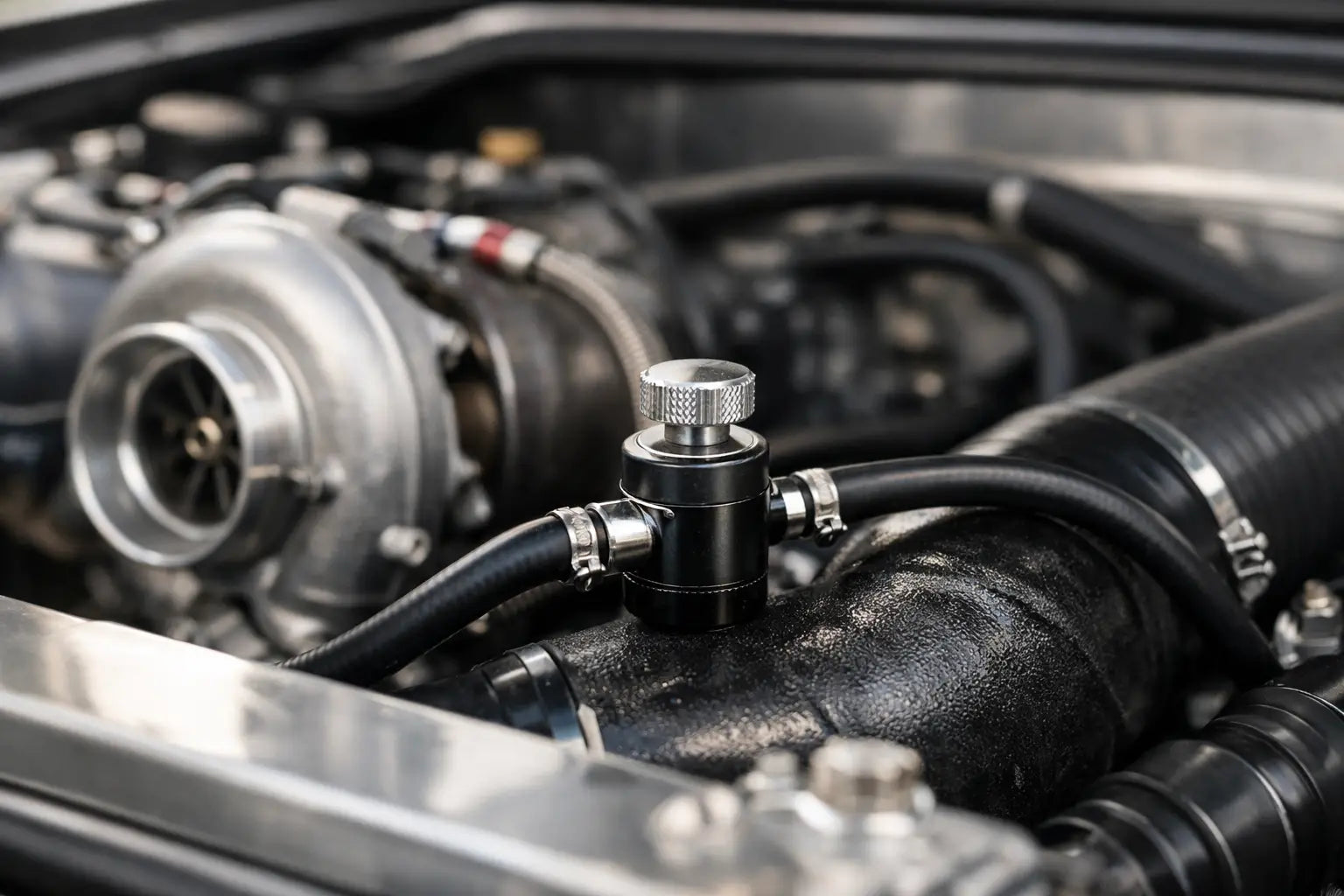
A manual boost controller is one of the quickest ways to change how a turbocharged car feels, but it is not a universal shortcut to safe power. This manual boost controller guide is for owners who want a firmer, more responsive boost delivery while keeping the wastegate, fuelling, calibration and engine limits firmly in view.
A small controller can raise boost in minutes. The expensive part comes later if the engine is asked to run pressure, ignition timing or air-fuel ratios it was never mapped to handle. Treat boost control as part of a complete package, not a standalone power mod.
What a manual boost controller actually does
Your turbocharger makes boost by using exhaust energy to spin the turbine. The wastegate limits that boost by bypassing exhaust gas around the turbine once a set pressure reaches its actuator. A manual boost controller sits in the pressure line feeding that actuator and changes when, or how quickly, the actuator sees pressure.
By delaying the pressure signal, the controller keeps the wastegate shut for longer. The turbo then produces more boost before the wastegate begins to open. More boost can mean more torque and power, provided the engine has enough fuel, suitable ignition timing, adequate charge-air cooling and a calibration that supports the target pressure.
That final part matters. Boost pressure is not a power figure and it is not a safety figure. A healthy 1.2-bar setup on one engine might be completely inappropriate on another, particularly where compression ratio, turbo efficiency, fuel quality and ECU strategy differ.
Manual boost controller types
The two common designs are bleed-type and ball-and-spring controllers. Both can work, but they manage the wastegate signal differently.
A bleed controller vents a controlled amount of pressure from the actuator line. It is simple and inexpensive, although it can be less precise and may allow the wastegate to start opening gradually. It is generally best suited to straightforward, older turbo systems where the aim is a modest increase rather than highly repeatable boost control.
A ball-and-spring controller, sometimes called a manual boost valve, holds pressure back until it reaches the spring setting. Once it opens, the wastegate receives a stronger pressure signal. This can help the turbo reach target boost sooner and reduce wastegate creep at lower settings. Quality units tend to offer more consistent adjustment than cheap generic valves, but they still cannot compensate for a poor base setup or an unsuitable map.
Some controllers include a cabin-mounted adjuster. That sounds useful, especially for cars used on road and track, but it also makes it easier to change a critical setting without checking the data. If you fit one, mark the safe position and avoid adjusting it mid-session or on the move.
Before fitting a manual boost controller
Start with a mechanically sound car at its factory boost setting. A controller will expose existing problems rather than solve them. Split vacuum hoses, a weak actuator, boost leaks, tired spark plugs or a blocked fuel filter can all produce misleading results.
Before you turn the adjustment screw, check four areas:
- Confirm actual boost with a reliable gauge or ECU data logging, not the original dashboard needle alone.
- Pressure-test the intake system and inspect every hose between turbo, intercooler, inlet tract and wastegate actuator.
- Verify that the engine management calibration, injectors, fuel pump and fuel pressure are suitable for the boost target.
- Check plugs, coils, cooling system condition and oil supply, particularly on a high-mileage or recently purchased turbo car.
How to fit a manual boost controller
Installation varies by engine, so use the manufacturer instructions and a model-specific vacuum routing diagram. On a conventional internal-wastegate turbo system, the controller normally goes in the line between the turbo compressor housing pressure source and the wastegate actuator.
Keep hose runs short, heat-resistant and tightly secured. Use proper vacuum hose of the correct internal diameter, not random silicone offcuts that can soften near the turbine housing or loosen under pressure. Route the line away from the exhaust manifold, downpipe and sharp edges. A melted or detached line can leave the wastegate without a proper pressure signal, which may cause dangerous overboost.
Pay attention to flow direction. Ball-and-spring controllers are directional, and fitting one backwards may result in no boost control, unstable boost or a setting that behaves nothing like the adjustment suggests. If the kit includes a restrictor, check whether it is intended for your specific actuator arrangement. Do not add restrictors because somebody on a forum used one on a different platform.
If your car has a factory boost control solenoid, do not assume it can simply be removed. Some ECUs monitor its operation and will log a fault. Others use it as part of a wider closed-loop control strategy. Understand the system before altering pipework.
Setting boost without chasing the biggest number
Begin with the controller set to its lowest boost position. Make a short, controlled pull in an appropriate gear and record peak boost, how quickly it arrives and whether it holds steadily towards the redline. Increase the setting in very small increments, then repeat the test under similar conditions.
Do not set boost from a single third-gear pull on a cold evening and assume the job is finished. Ambient temperature, road load and gear choice all affect what the turbo does. A car that looks fine in a brief low-load test can overboost in a taller gear, particularly with a free-flowing exhaust or an aggressive turbo setup.
Watch for boost spike, boost creep and boost taper. A spike is a short overshoot above your intended pressure, often caused by slow wastegate response or an overly aggressive controller setting. Creep is a gradual rise in boost at higher rpm when the wastegate cannot bypass enough exhaust gas. Taper is a drop in boost near the top of the rev range, which may be normal for the turbo and calibration, or a sign of a leak, weak actuator or restrictive setup.
The right target is the pressure your mapped setup can reliably support, not the maximum number the gauge will show. If you are running a stock ECU map, the sensible answer is often to leave boost alone. A controller cannot add fuel or remove ignition timing when knock starts. It only changes pressure.
Use data, not guesswork
A boost gauge is the minimum. For any meaningful increase, log air-fuel ratio, intake air temperature, ignition correction or knock activity where your ECU provides it, and fuel pressure on systems where it can be monitored. Wideband lambda data is especially useful on older or aftermarket-managed cars, but it still needs to be interpreted alongside the rest of the setup.
Listen for detonation, but do not rely on your ears. By the time audible knock is obvious, the engine may already be under serious stress. Sudden power loss, misfires, smoke, unusually high coolant temperature or repeated overboost codes are all reasons to stop testing and investigate.
This is where a reputable tuner earns their place. A calibrated boost target, matched to the fuel available and the turbo's efficient range, produces a faster car than a random pressure increase that heat-soaks after one hard pull. For track use, consistency matters even more than peak dyno output.
When a manual controller makes sense
A manual controller suits simple, mechanically controlled turbo setups, budget-conscious builds and owners who understand the limits of their existing map. It can also be useful where a basic system needs modest boost adjustment and there is reliable instrumentation to verify the result.
It is less suitable for modern ECU-managed cars, variable-geometry turbo diesels, high-power builds with narrow safety margins, or cars that need selectable boost modes and closed-loop correction. In those cases, an electronic controller or ECU-based boost strategy gives better control, better repeatability and often better protection.
For a well-matched parts package, Torque Lab’s performance-focused catalogue makes it easier to build around the controller rather than treating it as the whole upgrade. Think charge cooling, fuelling, exhaust flow, gauges and calibration as connected decisions.
A manual boost controller is a small component with a big influence over cylinder pressure. Set it conservatively, verify every change with real data, and let the engine’s hardware and calibration decide the limit rather than the number printed on the boost gauge.