
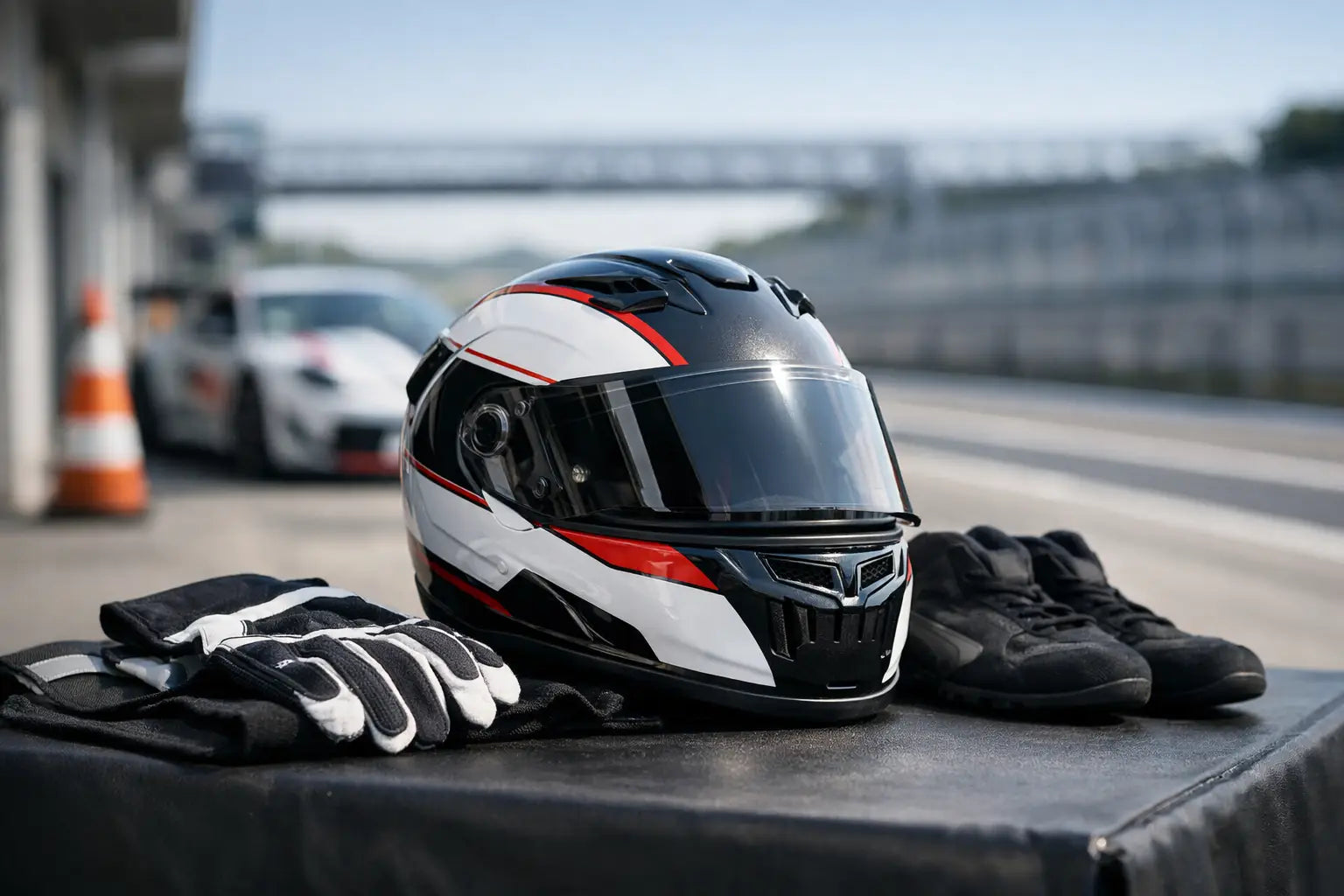
You notice a bad helmet the first time you wear it for a full session. Hot spots on your forehead, lift at speed, a visor that fogs when the paddock is damp, or a shell that technically passes scrutineering but leaves you counting the minutes until the chequered flag. A proper motorsport helmet buying guide is not about picking the one with the best graphics. It is about getting the right approval, the right fit, and the right features for how you actually drive.
If your car is already sorted with decent brakes, tyres and cooling, your helmet should be held to the same standard. It is safety gear, but it is also a performance part. A helmet that fits properly lets you focus on braking points, mirrors and traffic. One that does not becomes a distraction you feel every lap.
Motorsport helmet buying guide - start with your use case
The first decision is not brand. It is where the helmet will be used. Track day rules, sprint events, hill climbs, drift competitions and circuit racing do not always ask for the same standard. Some organisers are relaxed on helmet approvals. Others are strict, and if your lid is out of date or carries the wrong sticker, you are not going out.
That means your buying decision should be based on the highest level of use you expect in the next few seasons, not just your next event. If you are currently doing open pit lane days but plan to move into competition, buying once is usually cheaper than replacing an entry-level helmet a year later.
For casual track work in a road car, you may be looking at a helmet acceptable for general circuit use. For motorsport competition, FIA approval often becomes the key requirement. Always check the rulebook for your championship or organiser because wording matters. "Motorsport approved" is not specific enough when scrutineering starts.
Certification matters more than marketing
This is where plenty of buyers get caught out. Product descriptions often lean heavily on comfort, shell material and style, but the approval label is the part that gets you on track.
The two things to understand are the safety standard itself and whether that standard is accepted by your organiser. An FIA-approved helmet is typically the safer bet if you are buying with motorsport in mind, especially if there is any chance of future competition use. Some helmets may carry other recognised approvals, but that does not automatically make them suitable for every event.
You also need to watch the expiry window for certain regulations. A helmet can be genuine, high quality and still be effectively obsolete for the series you want to enter. If a bargain price looks too good, there is often a reason.
The practical move is simple. Buy the helmet that meets your current needs and still gives headroom for where your build and driving are heading next.
Open-face or full-face?
For most circuit and higher-speed applications, full-face helmets are the obvious choice. They offer better facial protection, better integration with visors, and generally suit cars where debris, close proximity driving or higher risk is part of the picture.
Open-face lids still have a place in some disciplines and some cars, especially where visibility and cockpit layout make them viable. But if you are unsure, full-face is usually the safer and more versatile direction. It also tends to work better if you later move into more serious competition.
Fit is everything
The best helmet on paper is the wrong helmet if the fit is off. This is the part buyers rush, and it is the part that matters most once the session starts.
A motorsport helmet should feel snug all around your head without sharp pressure points. It should not move independently when you turn your head, and it should not be easy to roll off or shift excessively when fastened. The cheek pads should feel firm. New helmets often feel tighter than people expect, and that is not necessarily a problem. Linings bed in slightly over time.
What you do not want is immediate pain on the brow or temples, or a loose fit that allows movement under braking and cornering loads. Head shape also matters. Some brands suit rounder heads, others more oval profiles. Two helmets in the same size can feel completely different once on.
If you wear glasses, test that as part of the fit rather than as an afterthought. A helmet can fit perfectly without glasses and become unbearable with them in place.
Sizing charts help, but they do not finish the job
Measure your head properly and use the manufacturer chart as a starting point, not a guarantee. If you land between sizes, the correct choice depends on the brand, interior shape and how much bedding-in you expect. Going larger for comfort in the garage often turns into a loose helmet on track.
Shell material - where budget and weight meet
Most buyers will come across thermoplastic, fibreglass composite, carbon-fibreglass blends and full carbon options. The trade-off is usually price against weight.
A heavier helmet is not automatically bad, but weight becomes noticeable over long sessions and in cars with stiff suspension, kerb strike and high vibration. Lighter shells reduce fatigue, which is useful if you are doing repeated sessions or endurance-style driving. That is one reason premium helmets command stronger prices.
Fibreglass and composite helmets often hit the sweet spot for club-level users because they balance cost, safety and comfort well. Carbon helmets save more weight and look the part, but the performance gain only makes sense if the budget allows and the rest of your use case justifies it.
Do not buy carbon just for the look. Buy it if lower weight genuinely matters to your driving, your event schedule or your cockpit environment.
Ventilation, visor quality and real-world comfort
Comfort features are not fluff. They affect concentration.
Good ventilation helps on warm days, in closed cockpit cars and in long queues before release. A poor visor system becomes obvious in rain, cold mornings or humid paddocks. Fogging, awkward visor changes and poor sealing are the kind of details that make cheap helmets feel cheap very quickly.
Visibility also matters more than many first-time buyers think. A wide eye port helps with mirrors, apex spotting and situational awareness in busy sessions. In disciplines where traffic management is part of the job, that is not a minor detail.
Interior linings deserve attention too. Removable, washable liners make sense if you use the helmet regularly. If you share a car, travel often, or drive in summer heat, easy cleaning is worth having.
HANS compatibility is not optional if you need it
If your series or setup requires a head and neck restraint, your helmet needs to work with it properly. That means checking for HANS posts or compatibility from the start.
This is another area where future planning matters. Even if you are not using a restraint device yet, buying a helmet ready for one can save hassle and cost later. For many drivers moving from track days into regulated motorsport, this becomes relevant faster than expected.
Do not assume every helmet can simply be adapted. Some can, some come pre-fitted, and some are better suited than others. Match the helmet to the restraint system and your intended discipline.
What to avoid when buying
The biggest mistake is buying on appearance alone. Graphics, replica designs and social media popularity do not tell you how a helmet fits, what standard it meets or whether it will still be valid next season.
The second mistake is buying too cheaply for the intended use. There is a difference between value and false economy. If you end up replacing a helmet because the approval is wrong, the fit is poor or the shell is too heavy for regular use, the cheaper option was not cheaper.
The third is ignoring event regulations until the week before the booking. By then you are shopping under pressure, stock is limited, and compromise starts to look acceptable.
A used helmet is another grey area. Unless you know its full history, including impacts and storage conditions, it is hard to recommend. Damage is not always visible, and sweat-soaked interiors or degraded components are more common than sellers admit.
The best helmet is the one that matches your motorsport plan
A proper motorsport helmet buying guide should leave you with a narrower, smarter shortlist. Start with certification. Then choose full-face or open-face based on discipline. Get the fit right. After that, compare shell material, weight, visor quality, ventilation and HANS readiness.
If you are building a car properly, treat your helmet the same way you treat suspension or brake selection. Buy for the job, not for the photo. The right lid feels secure, stays comfortable deep into a session, and leaves you thinking about the next lap instead of the pressure on your forehead.
That is usually the clearest sign you bought well.