
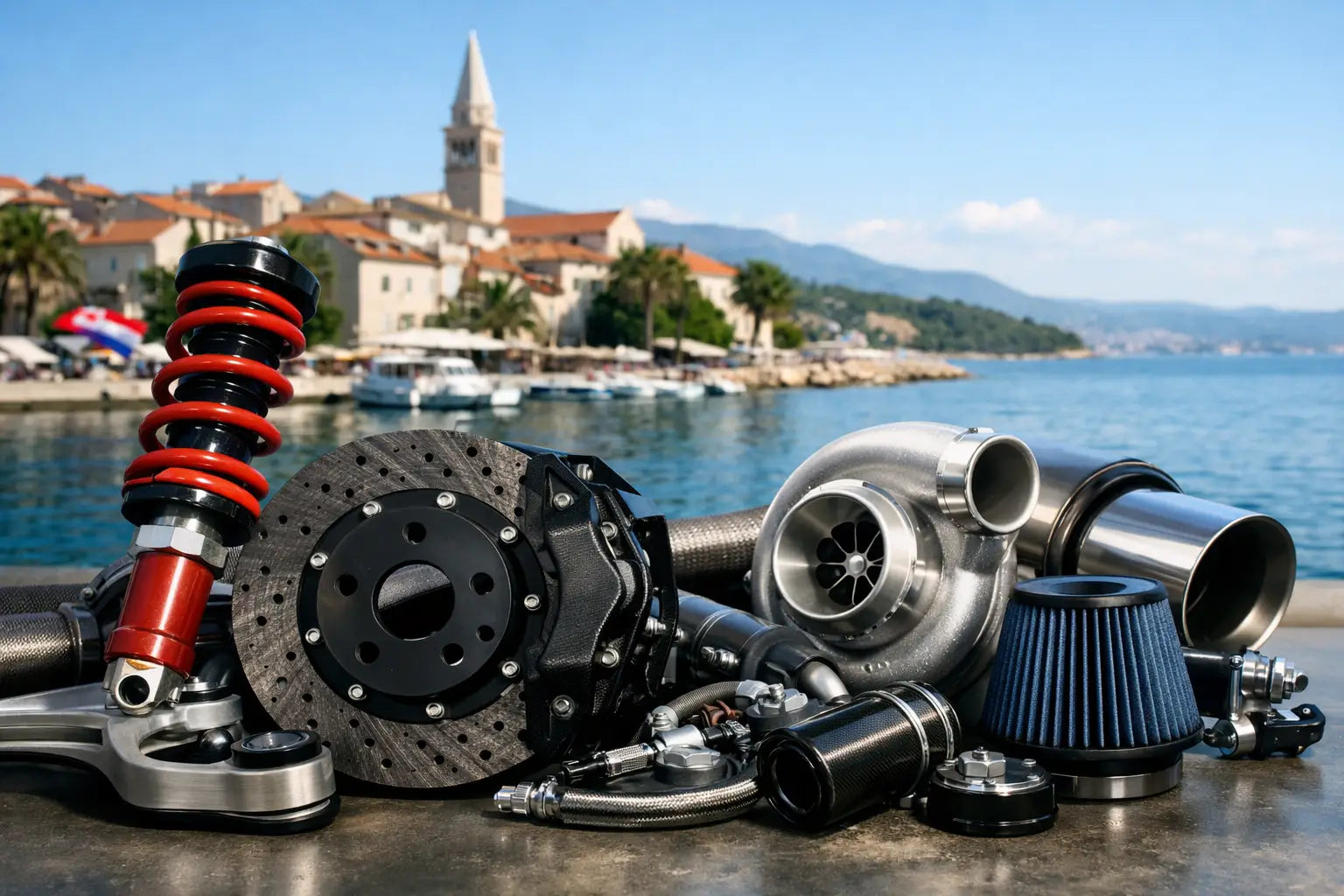
You can waste a lot of money modifying a car by buying the right part at the wrong stage. That is usually the real problem with shopping for performance parts Croatia enthusiasts want - not lack of choice, but too much of it, mixed with vague fitment, mixed-quality brands, and upgrades that look impressive on paper but do not suit the build.
If you are building a fast road car, weekend track toy, or a sharper daily, the goal is not simply to add parts. The goal is to create a package that works together. Better braking without tyre grip is half a job. More boost without cooling and fuelling support is asking for trouble. A lower ride height without damper control can make a car worse, not better.
What matters when buying performance parts in Croatia
The smartest buyers start with use case. A road-driven Golf GTI, Civic Type R, GR Yaris, M140i or Octavia vRS does not need the same setup as a time attack build or drift car. That sounds obvious, but plenty of people still shop by headline numbers instead of intended use.
For a fast road build, you usually get the best return from handling, braking and thermal control before chasing big power. Good pads, quality discs, braided lines, a suspension kit matched to the car, and proper tyres transform how the car feels every day. It is not the most glamorous shopping basket, but it is often the one you feel most from behind the wheel.
For track work, priorities shift. Brake temperature management, consistent damping, oil and coolant control, and dependable fuelling matter more than pub-spec dyno figures. That is where brand quality stops being a nice extra and starts becoming the difference between a solid session and a car parked in the paddock with the bonnet up.
Start with the category that changes the car most
Brakes first if the car is underprepared
A lot of builds are still running factory-level braking with a power target that moved on months ago. That is the classic weak link. If your current setup fades after a few hard pulls or one track session, the answer is not always a huge big brake kit straight away. Sometimes it is better pads, better fluid, and discs that can take heat repeatedly.
Brands such as EBC Brakes and Ferodo remain popular for a reason. They are familiar to enthusiasts, available across a wide range of platforms, and offer compounds that suit different use cases. Daily road driving, spirited B-road use and circuit work all ask for something different. The trade-off is simple - the more track-focused the pad, the more likely you are to accept noise, dust or reduced cold bite.
Suspension changes how the whole build feels
If you want the car to feel more tied down, more responsive and more confidence-inspiring, suspension is often the real turning point. Coilovers from established names such as BC Racing give buyers a practical route into proper damping control and ride height adjustment without drifting into unknown-brand territory.
That said, lower is not always faster. A badly set up car on stiff, cheap suspension can skip across rough roads and lose composure exactly where you wanted more grip. Platform-specific fitment matters here. So does honesty about how you use the car. If it spends 95 per cent of its life on the road, buy for road performance first and occasional circuit use second.
Cooling and intake upgrades earn their keep
Engine cooling parts are rarely the first thing enthusiasts get excited about, but they become very interesting when intake temperatures climb, coolant temps creep, or repeated pulls start producing inconsistent performance. Mishimoto sits in that conversation because cooling is one of those categories where known quality pays off quickly.
The same logic applies to intake upgrades. A decent intake can improve response, sound and airflow, but not every setup delivers the same result on every platform. Some are worth the spend. Some are mostly noise. The difference is usually in the broader setup, the engine platform and whether the part has actually been chosen to support the next stage of the build.
Performance parts Croatia shoppers should prioritise by build goal
For a sharp road car
Focus on tyres, brake pads, fluid, suspension and a sensible alignment. Add intake or exhaust upgrades if you want more response and character, but get the chassis right first. This route suits the majority of enthusiast road cars and gives the biggest improvement per pound spent.
For a track-day car
Move cooling, braking and suspension right to the top of the list. If you are increasing power, support it properly with fuelling and thermal management. Track cars expose weak points quickly, so the parts list needs to be honest rather than aspirational.
For a power build
Turbo, intercooler, exhaust, fuelling and ECU-related hardware need to be treated as one system. It is rarely wise to buy a headline power part in isolation. Forced induction setups especially reward complete planning and punish corners cut on supporting components.
Why fitment accuracy matters more than hype
Enthusiasts do not need to be told that brand reputation matters, but fitment accuracy is where a lot of buying decisions are won or lost. The right part for the wrong engine code, chassis version or brake setup is still the wrong part. This becomes even more important with platform-specific upgrades across VAG, BMW, Honda, Toyota and Renault applications, where small spec differences can affect compatibility.
A good performance parts retailer does not just throw thousands of SKUs onto a page and hope for the best. It helps buyers narrow by vehicle, category and brand so you can actually build a coherent basket. That sounds basic, but in the aftermarket it is a real advantage. It saves time, reduces mistakes, and stops projects stalling because one part in the order was guessed rather than confirmed.
Brand choice is not just about prestige
There is a difference between paying for a logo and paying for proven engineering. Recognised aftermarket names have earned their place because they repeatedly show up on serious builds, survive hard use, and offer consistency across product lines. Milltek, HKS, Mishimoto, BC Racing, EBC Brakes, Ferodo and Apex Wheels all speak to different priorities, but the common thread is credibility with enthusiasts who actually use their cars properly.
That does not mean the most expensive option is always the correct one. It means you should know what you are paying for. Better materials, platform-specific development, better thermal performance, more predictable wear, cleaner fitment and stronger aftersales confidence all matter. On some builds, premium parts are essential. On others, a mid-range option from a trusted manufacturer is the sensible call.
How to avoid buying the wrong parts
The usual mistake is buying too early, too cheaply, or too randomly. A car with mismatched upgrades often ends up feeling unfinished because the owner chased deals instead of building a proper roadmap.
Start by asking a few blunt questions. What is the car for? What is the actual budget, including consumables and fitting? What is the next stage after this purchase? If you cannot answer those clearly, you are more likely to buy parts twice.
It also pays to think in systems rather than single products. Wheels change tyre options and unsprung weight. Suspension changes alignment needs and ride quality. Brake upgrades affect wheel clearance. Exhaust choices can shape drone levels on the motorway. Good builds come from understanding those knock-on effects before the checkout, not after delivery.
Where an enthusiast-focused retailer makes the difference
When you are shopping performance parts in Croatia or anywhere else in Europe, speed of access matters, but curation matters just as much. A catalogue built for enthusiasts is easier to use because it reflects how enthusiasts actually shop - by platform, by problem, by power goal and by trusted manufacturer.
That is where a specialist retailer like Torque Lab fits naturally. Not because it sells generic replacement parts with performance branding attached, but because the product range is built around genuine upgrade paths. Brakes, suspension, intake, drivetrain, cooling, fuelling, exhaust, electronics, forced induction, wheels and motorsport gear all sit in one place, which makes it far easier to plan a build properly instead of patching it together from random sources.
For buyers in Croatia, that matters most when the car is not standard and the shopping list is no longer simple. Once you are combining fitment-specific parts across multiple categories, confidence in the catalogue becomes part of the product.
Performance parts Croatia buyers should treat as long-term decisions
Some upgrades are easy to reverse. Others shape the car for years. Suspension, wheel fitment, brake setup and forced induction choices are not throwaway purchases, so it pays to choose parts that still make sense six months from now.
A well-built car is not the one with the longest mod list. It is the one where each part has a job, each upgrade supports the next, and the whole package feels sorted on the road or at the circuit. Buy with that mindset and you stop chasing noise. You start building a car that actually delivers when it matters.