
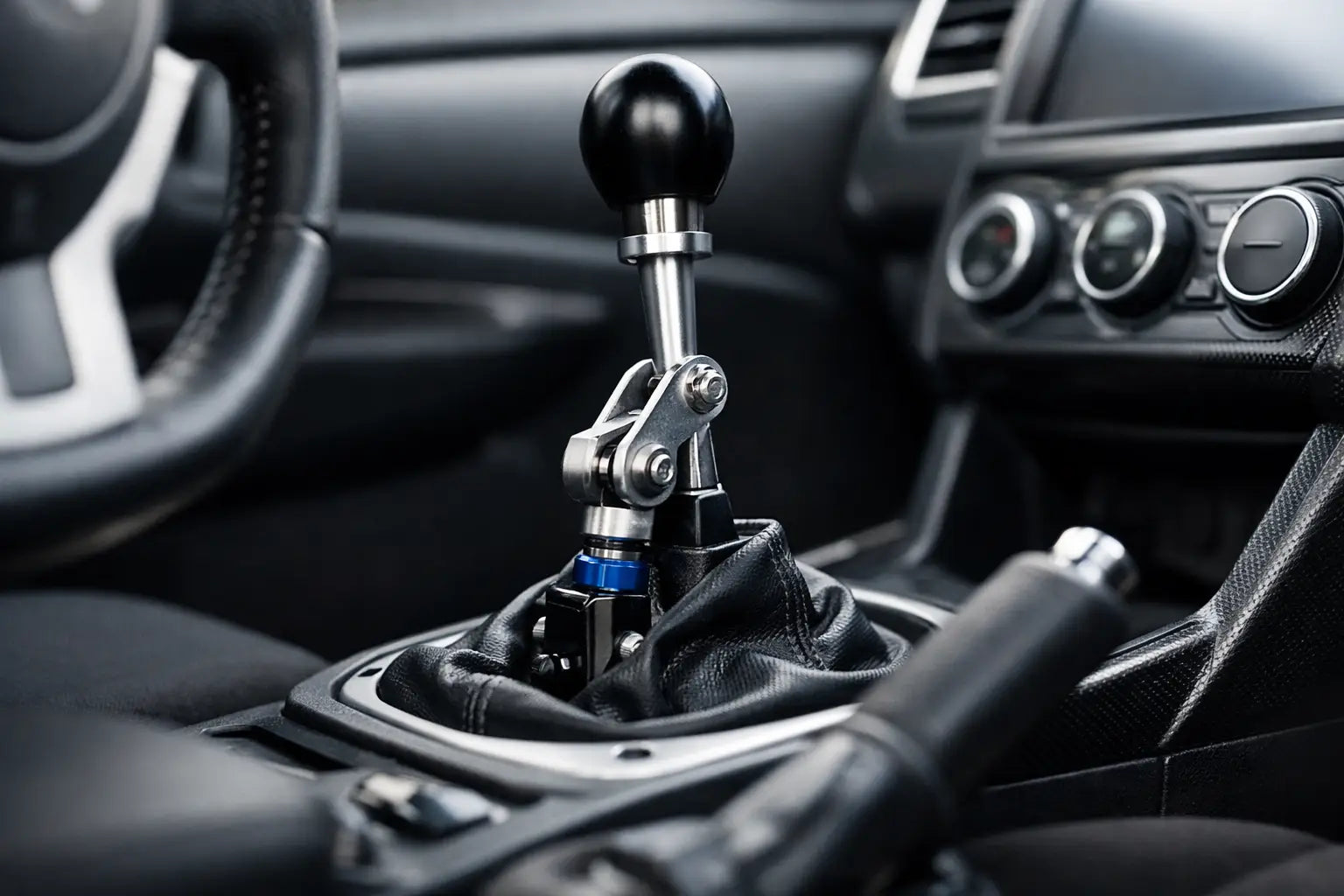
Miss a 3-4 upshift once on track, or fumble second at a stoplight, and you start paying attention to how much wasted movement lives in a factory shifter. That is where short shifter benefits explained actually matters - not as forum hype, but as a real drivetrain feel upgrade that can change how connected the car feels every time you grab a gear.
A short shifter is one of those mods that sounds bigger than it is, yet often feels more noticeable than parts with far flashier marketing. It does not add horsepower. It does not fix a weak synchro. What it does is reduce the throw between gears and tighten the action at the lever, which can make the whole car feel sharper, more deliberate, and more performance-focused.
For enthusiasts building a street car with track-day intent, or a dedicated weekend machine that needs faster, cleaner shifts, that matters. But like most worthwhile mods, the result depends on the platform, the quality of the part, and what you expect from it.
Short shifter benefits explained for real-world driving
The main benefit is simple: less hand movement between gears. A short shifter changes the lever geometry so you can engage the next gear with a shorter throw than stock. In practice, that means the shift pattern feels tighter and more compact.
On a spirited back road or during hard sessions at the track, shorter throws can help reduce the time and motion involved in shifting. You are not transforming the gearbox itself, but you are cutting out some of the excess travel that makes many OEM shifters feel rubbery or slow. In cars with especially long factory throws, the difference can feel dramatic.
The second major benefit is improved shift feel. A good short shifter often gives each gate a more mechanical, more positive action. Instead of rowing through a long, vague movement, you get a more defined engagement that tells your hand exactly what the transmission is doing. That added precision is a big reason enthusiasts rate this upgrade so highly.
There is also a confidence factor. When the lever feels direct and the gates are easier to locate, quick shifts become less of a guess and more of a repeatable action. That can help on track, but it is just as valuable in daily driving when you want the car to feel crisp instead of soft.
What actually improves with a short shifter
The biggest improvement is driver interface. You interact with the shifter constantly in a manual car, so even a modest change in feel gets noticed every time you drive. Unlike some upgrades that only show benefits in narrow conditions, a short shifter affects normal commuting, hard driving, autocross, and track use.
Faster shifts are part of the appeal, but the phrase needs context. A short shifter can help you shift faster because your hand travels less distance. That does not automatically mean you should slam gears harder. The goal is efficient, accurate movement, not brute force. A quality setup rewards clean inputs.
It can also improve rhythm. When the shifter moves through a shorter arc, heel-toe downshifts, quick upshifts, and transitions between corners can feel more natural. This is especially true in cars where the stock shifter has excessive play or a high, stretchy throw that slows down your hand speed.
Another benefit is subjective but very real: the car feels more serious. Enthusiasts talk a lot about steering feel, pedal feel, and brake feel. Shifter feel belongs in that same conversation. If you enjoy a mechanical connection to the car, a short shifter often delivers more satisfaction per dollar than people expect.
Where the trade-offs start
This is not a magic mod, and it is not ideal for every build. Shorter throws usually mean increased effort at the lever. That is normal. Since you are changing leverage, the shift can feel heavier than stock, especially in traffic or during cold starts when the transmission fluid has not warmed up.
You may also notice more vibration, noise, or drivetrain feedback depending on the design. Some assemblies use stiffer bushings or more rigid hardware, which can sharpen feel but also pass more mechanical sensation into the cabin. For a track car, that is rarely a problem. For a daily driver that sees a lot of stop-and-go miles, it may be something to think about.
Then there is the issue of quality. Not every short shifter is well engineered. Cheap kits can create notchiness, poor centering, awkward gate alignment, or accelerated wear if tolerances are off. This is one of those categories where brand credibility and platform-specific design matter a lot.
And no, a short shifter will not repair an already tired transmission. If the gearbox has synchro problems, excessive slop in the linkage, worn bushings, or damaged mounts, the new shifter can make those issues more obvious rather than hide them.
Short shifter benefits explained by build type
For a street-driven performance car, the sweet spot is a short shifter that cuts throw moderately while keeping good refinement. Too aggressive, and the car can become annoying in everyday use. A balanced setup usually gives you tighter gates and better feel without making every school run feel like a touring car pit lane.
For autocross and track-day builds, the benefits are easier to justify. Faster, more direct shifts matter more when you are driving at the limit and working the gearbox under pressure. Cleaner engagement between gears can help reduce hesitation, especially in sections where a delayed shift costs time and momentum.
For dedicated motorsport cars, a short shifter makes sense as part of a broader driver-control package. Once you pair it with firmer transmission mounts, upgraded bushings, a stronger clutch line feel, and supportive seating, the cockpit starts working as a system. That is when this mod really earns its place.
Should you pair it with other parts?
Often, yes. A short shifter on its own can be excellent, but it tends to perform best when the rest of the linkage and mounting hardware are in good shape. Worn shifter bushings, soft transmission mounts, or sloppy cable assemblies can limit the result.
Many enthusiasts get the best outcome by combining a short shifter with upgraded bushings or a revised shifter base. That can remove free play and sharpen gate definition even further. Just be careful not to overbuild the setup for your use case. A street car still needs to be enjoyable on regular roads, not just in paddock conversations.
If your platform is known for a soft factory shifter, this upgrade can be especially worthwhile. Honda, BMW, Volkswagen, Toyota, and many other enthusiast platforms often respond well when the aftermarket addresses factory compromise points. The key is choosing parts built specifically for your chassis rather than generic hardware with a broad fitment claim.
How to know if a short shifter is worth it
If you already like driving a manual and want the shift action to feel tighter, more mechanical, and more performance-oriented, it is probably worth it. If your stock throws feel long, vague, or disconnected, the upgrade makes even more sense.
If your car spends most of its life in urban traffic and comfort matters more than feedback, it depends. You may still enjoy the improved precision, but an aggressive setup could get old fast. This is where product choice matters more than the mod category itself.
It is also worth asking what bothers you about the current setup. If you hate the length of the throw, a short shifter addresses that directly. If you hate grinding into second, fix the gearbox issue first. If you want the car to feel more alive without chasing power gains, this is one of the cleaner ways to do it.
The bottom line on short shifter benefits explained
A good short shifter makes the car feel tighter, quicker, and more intentional from the driver’s seat. The real gains are shorter throws, more defined engagement, and a stronger connection between hand and gearbox. For many enthusiast builds, that is enough to make the car more rewarding every single drive.
Just keep your expectations realistic. This is a feel mod, not a dyno mod. Done right, though, it is the kind of upgrade that reminds you why manual cars are still worth building. Choose a quality, platform-specific setup, match it to how you actually use the car, and you will feel the difference long before the next headline horsepower part shows up at your door.