
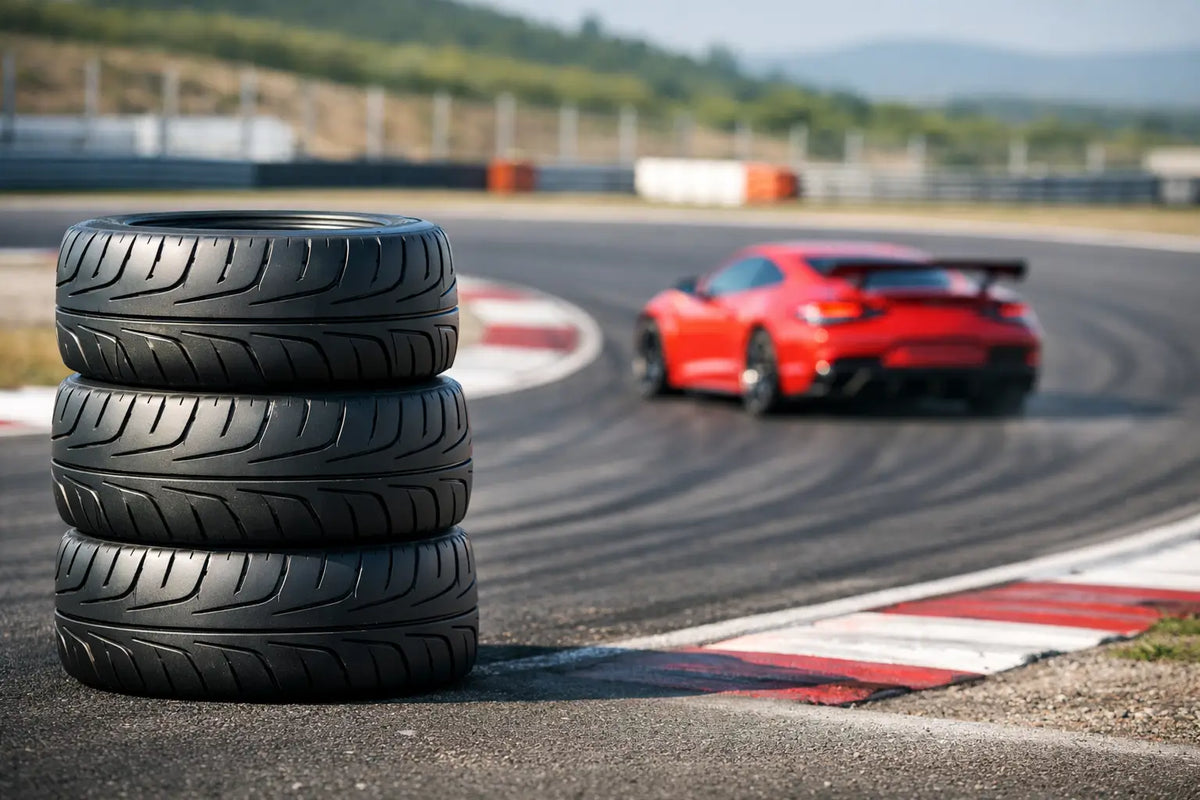
The fastest way to ruin a good track day is showing up on the wrong tire. Too much tire, and you waste money while masking bad habits. Too little tire, and the car overheats its shoulders, goes greasy after a few laps, and chews through tread before lunch. If you are asking what tires are best for track days, the real answer starts with your car, your pace, and how you use it between events.
For most drivers, the sweet spot is not a full race slick and it is not a random ultra-high-performance street tire either. The best track day tire is usually the one that matches your car’s weight, power, alignment, and consistency level. That is why experienced drivers stop asking for the single best tire and start asking what works best for their setup.
What tires are best for track days? Start with your use case
A front-wheel-drive hot hatch on stock suspension wants something different than a caged rear-wheel-drive coupe on camber plates and square fitment. The same goes for a dual-duty street car versus a trailered build. If you drive to the track, drive home, and see the occasional rain shower, your tire choice needs to leave some margin.
Most track day drivers fall into three practical categories. First, there is the beginner or occasional driver who needs a tire that survives street miles, gives predictable breakaway, and does not punish every setup mistake. Second, there is the intermediate regular who wants repeatable lap-to-lap grip, sharper response, and better heat tolerance. Third, there is the advanced driver chasing lap time, where the focus shifts toward outright dry grip and managing wear as a consumable.
That is why one tire can be brilliant for one car and a bad buy for another. You are not just buying grip. You are buying a heat window, sidewall behavior, wet performance, noise, tread life, and tolerance for imperfect alignment.
The three tire types that matter most
For track days, the conversation usually lands on max-performance street tires, 200-treadwear extreme performance tires, and R-compound tires. Each has a place.
Max-performance street tires
These are the easiest entry point. They are road friendly, decent in the wet, and usually cheaper than more track-focused options. For a novice driver doing a few sessions per year, they can make sense because they communicate well and do not instantly overwhelm the chassis.
The trade-off is heat. On a heavier car, or with a driver pushing harder each session, many street-focused tires start to smear, overheat, and lose consistency. You might get one strong lap, then a noticeable drop. If your brakes and suspension are improving but the tire is still the weak link, it is time to move up.
200TW extreme performance tires
For most enthusiasts, this is the answer to what tires are best for track days. A good 200TW tire gives strong dry grip, quicker steering response, and enough durability to survive street use if you are realistic about mileage. They are the go-to choice for dual-duty builds and grassroots motorsport because they bridge the gap between daily usability and genuine track performance.
They are not all the same, though. Some 200TW tires are almost autocross specialists with huge peak grip but limited heat tolerance over longer sessions. Others are better for repeated hot laps and heavier cars. If you run a turbo hatch, a BMW on square setup, or a tuned GR86 that sees real circuit time, this category is usually where the best value lives.
R-compound tires
If the car is heavily track biased and lap time matters more than comfort, R-compound rubber is the next step. These tires offer more dry grip, stiffer carcass construction, and higher limits, but they also ask more from the driver and the setup.
They can mask balance issues, wear quickly when alignment is off, and become expensive fast if you are still developing technique. In cooler weather they may need more care, and in standing water they can be a poor idea. For experienced drivers and dedicated builds, they are serious tools. For occasional track day use, they are often more tire than you actually need.
Why 200TW is usually the smart money
A strong 200TW tire works because it fits how most enthusiasts use their cars. You get enough grip to support brake upgrades, coilovers, and better alignment settings without stepping into full consumable-race-tire territory. You can drive to the event, put in multiple sessions, then drive home without swapping wheels in the paddock.
This category also gives you room to grow. A predictable 200TW tire teaches weight transfer, trail braking, and throttle application better than a tire with massive grip and a narrow operating window. You feel what the chassis is doing. That matters if you are trying to get quicker rather than just cover mistakes.
If your car is still mostly street driven, start here before chasing more aggressive compounds. In most cases, the car will reward a proper alignment, good brake pads, and a quality 200TW tire more than it will reward jumping straight to R-comps.
The car setup matters as much as the tire
A lot of people buy expensive tires and then wonder why the outer shoulders are destroyed after two events. Usually the answer is not the tire. It is setup.
Track use loads the tire much harder than street driving. If you are on factory alignment with limited negative camber, especially on McPherson strut front suspension, you will roll onto the sidewall and overheat the shoulder. That is common on front-wheel-drive Hondas, Volkswagens, Renaultsports, and many BMW street setups. More front camber, the right pressures, and enough brake support to manage entry speeds can completely change tire life.
Wheel width matters too. Stretching a performance tire onto a narrow wheel softens response and reduces support. Running a tire too wide for the wheel can also dull steering and compromise tread behavior. The best track tire on the wrong wheel is still the wrong package.
Then there is weight. A lightweight Miata or BRZ can get away with a tire that would wilt under a heavier Audi S4 or M340i. Power delivery changes things too. A torque-heavy turbo car will punish rear tires on corner exit in a way a naturally aspirated momentum car does not.
Common mistakes when choosing track day tires
The first mistake is buying for internet reputation instead of your actual use. A tire that dominates time attack talk might be terrible value on a commuter-track car that sees cold mornings and wet highways.
The second is ignoring heat management. Some tires feel amazing for one hot lap and then fade. Others come alive after a lap and stay there. If your local circuit has longer sessions, that difference matters more than hero-lap grip.
The third is underestimating pressures. Even the right tire will feel awful if hot pressures are way off. Too high and the contact patch shrinks, grip falls away, and the center wears. Too low and the tire rolls over and overheats the shoulders. Start with the manufacturer’s guidance, check hot pressures immediately after sessions, and adjust with intent.
The fourth is skipping a second wheel set when the car usage justifies it. If your car sees regular track use, dedicated track wheels and tires make life easier. You protect your street tires, gain fitment flexibility, and can choose a compound that actually suits the job.
How to choose what tires are best for track days on your car
If you are new, buy a durable max-performance or approachable 200TW tire that gives clear feedback. Do not chase the grippiest option on paper. Learn the car first.
If you are doing frequent events in a dual-duty build, buy a proven 200TW tire with solid heat tolerance and match it to proper alignment and brake setup. This is the zone where most track day cars should live.
If you are advanced, already have the suspension and alignment sorted, and care most about lap time, then step into more aggressive 200TW options or R-compounds with a realistic budget for wear.
For platform-specific shoppers, that usually means thinking in systems. A heavier MQB car, FK8, or M car may need a more heat-resistant option than a lightweight GT86 or EG hatch. A front-wheel-drive car may demand more camber support up front. A powerful rear-wheel-drive setup may need a tire with strong rear traction and stable breakaway rather than just headline grip.
That is also where buying from a specialist catalog helps. If you are already upgrading brakes, suspension, wheels, or cooling, tire choice should support the rest of the package instead of fighting it. That is how builds get faster and more consistent, not just more expensive.
The best track day tire is the one you can keep in its working window, lap after lap, without cooking it or driving around its weaknesses. Get that right and the whole car starts making more sense. Pick with honesty, set it up properly, and your next event will feel a lot less like guesswork.