
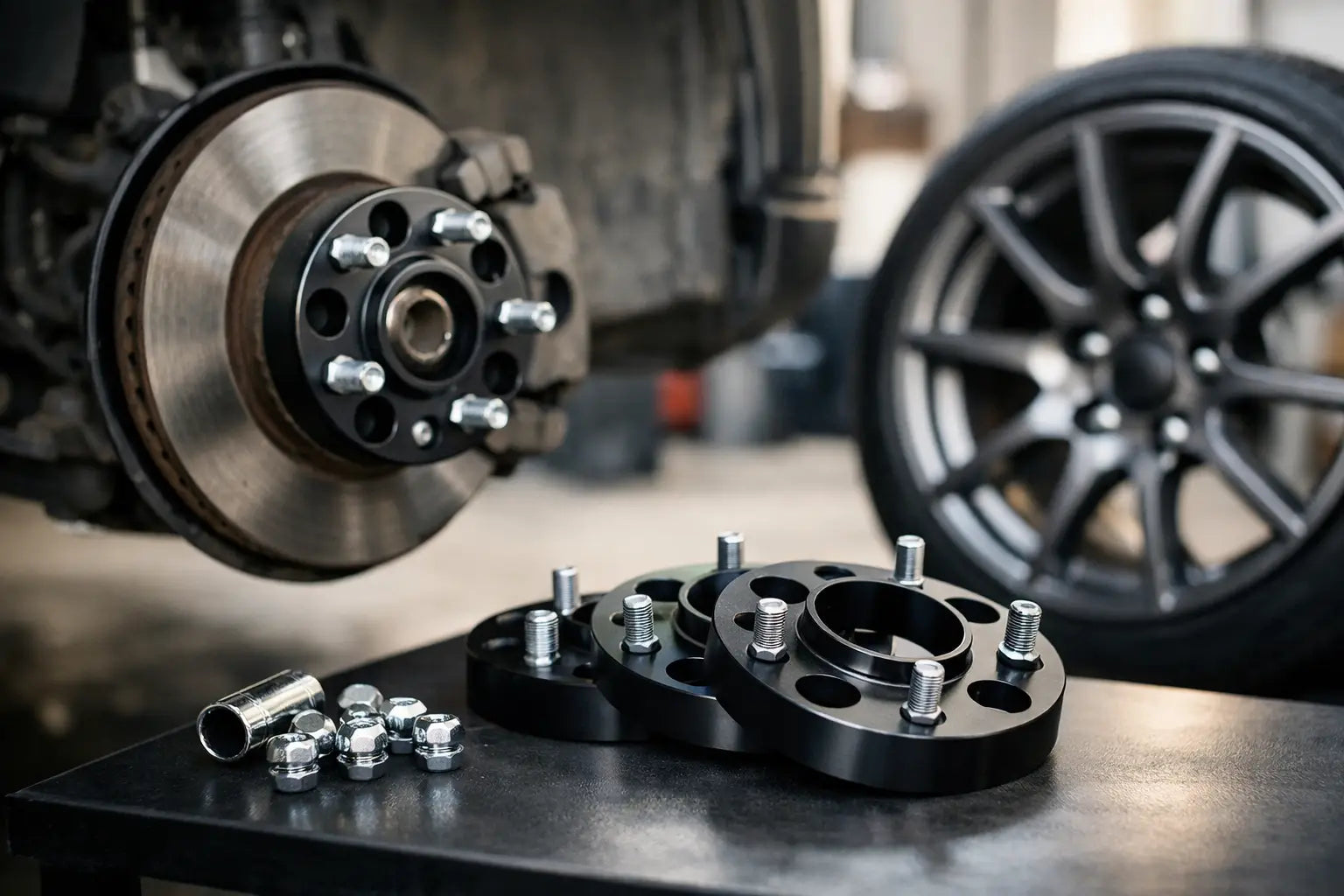
You notice bad spacer fitment fast. It shows up as steering wheel vibration at highway speed, rubbing on compression, or a wheel that looks right in photos but sits wrong in real life. A proper wheel spacer fitment guide is not about chasing the most aggressive number you can bolt on. It is about matching spacer size, hub fit, wheel specs, and intended use so the car actually drives the way it should.
What wheel spacers actually change
A wheel spacer moves the wheel outward from the hub. That sounds simple, but it affects more than just stance. You are changing effective offset, inner barrel clearance, outer fender position, scrub characteristics, and the load path through the hub and hardware.
For enthusiasts, spacers usually solve one of three problems. You need brake caliper clearance for a wheel that sits too close inboard. You want to flush out a conservative factory fitment. Or you are correcting wheel position after suspension and alignment changes. Each use case can be valid, but the right spacer thickness depends on the full setup, not just the look you want.
A 10 mm spacer, for example, reduces wheel offset by 10 mm. If your wheel is ET45 and you add a 10 mm spacer, the effective offset becomes ET35. That pushes the wheel 10 mm closer to the fender while also creating 10 mm more inner clearance.
Wheel spacer fitment guide - start with these measurements
Before you buy anything, you need four numbers and one basic reality check. The numbers are bolt pattern, center bore, wheel size, and current offset. The reality check is how much room you actually have on both sides of the wheel.
Bolt pattern has to match the car and the spacer exactly. A 5x112 car needs a 5x112 spacer. No workarounds, no close enough.
Center bore matters just as much. On a hub-centric setup, the spacer should locate properly on the vehicle hub and provide the correct lip for the wheel. If the spacer center bore is wrong, or the wheel is hanging on the lug hardware instead of being centered on the hub, vibration is much more likely.
Wheel width and offset tell you where the wheel already sits. If you know the current wheel clears everything with only a little room to spare, you can estimate how much spacer you can safely add. If you do not know your wheel specs, check the stamping on the inside of the wheel barrel or back pad.
Then measure real clearance. Look at the distance from the tire shoulder to the fender and from the wheel or tire to the strut, spring perch, or inner liner. A setup that looks like it has room in the garage may rub under cornering, braking, or suspension compression, especially on lowered cars.
Hub-centric vs lug-centric
If you care about proper fitment, hub-centric spacers are the move. They center on the hub and provide a matching lip for the wheel to sit on. That keeps the wheel properly located and reduces the chance of vibration caused by imperfect centering during installation.
Lug-centric setups rely on the lug hardware to center the wheel. Some cars and some wheel designs can tolerate that better than others, but for a street-and-track performance build, hub-centric fitment is the standard. It is simply the cleaner and more confidence-inspiring way to do it.
Material quality and machining also matter. Cheap spacers with poor tolerances can create problems even if the size looks correct on paper. This is one of those parts where quality control is not optional.
Choosing spacer thickness without guessing
The most common spacer sizes are 3 mm, 5 mm, 10 mm, 12 mm, 15 mm, 20 mm, and up. The best choice depends on what you are trying to fix.
A very thin spacer is often used for minor brake clearance or to fine-tune wheel position. The catch is that ultra-thin spacers can reduce available hub lip engagement. On some platforms, once you go past a certain thickness, you need a spacer with its own machined hub-centric lip because the factory hub lip is no longer long enough to center the wheel.
Mid-range spacers like 10 mm to 15 mm are common on enthusiast street cars because they can noticeably improve outer fitment while still being manageable if the wheel and tire package are sensible. Go thicker and you need to think harder about fender clearance, hardware type, and the overall geometry changes.
There is no universal best thickness. A 12 mm spacer might be perfect on one BMW with an 18x8.5 ET45 wheel and completely wrong on a lowered GTI running a wide tire. Platform, ride height, alignment, and tire shape all change the answer.
This is where rubbing happens
Tires are often the part that ruins the spreadsheet. Two 255 tires from different brands can measure differently in section width and shoulder shape. One may clear the fender, while another with a squarer sidewall catches the arch liner over bumps.
Lowering springs and coilovers make this more sensitive. Reduced ride height means less compression travel before the tire meets the fender or liner. Aggressive camber can help outer clearance, but it may also create other compromises in tire wear or straight-line braking feel if the alignment is pushed too far for a street-driven car.
Front axle fitment is usually more demanding because you are dealing with steering angle as well as vertical travel. A spacer that clears at static ride height may rub the liner or bumper tab at full lock. Rear fitment is often easier, but loaded passengers or track curbing can expose problems that did not show up during a quick test drive.
Wheel spacer fitment guide for hardware
Spacer hardware is not the place to improvise. If your car uses wheel bolts, adding a spacer means you typically need longer bolts with the same seat type as the wheel. If your car uses studs and nuts, you need enough thread engagement after the spacer is installed.
Seat type has to match the wheel. Ball seat and cone seat hardware are not interchangeable. Get this wrong and the wheel will not clamp correctly, even if the thread pitch is right.
Thread engagement is critical. The exact requirement varies by platform and hardware diameter, but the rule is simple: you need full, proper engagement, not a few turns and hope. On thicker spacers, many enthusiasts move to bolt-on spacer designs or stud conversions depending on the vehicle and use case.
Torque matters too. Use the correct torque spec, tighten in a star pattern, and re-check after the first heat cycle or short drive. If the spacer and wheel mounting surfaces are not perfectly clean and flush, torque readings do not mean much.
Street use, track use, and where the line moves
A spacer setup that works for street cruising may not be ideal for repeated hard track laps. Track driving increases heat, load, and the consequences of poor fitment. If the car sees autocross, HPDE, or time attack use, be more conservative with spacer thickness and more selective about parts quality.
This is also where brake clearance fitment needs extra attention. If you are spacing a wheel to clear a big brake kit, measure carefully around the caliper face and barrel. Do not assume that because one 18-inch wheel clears, every 18-inch wheel will. Spoke design changes everything.
Performance-minded buyers usually care about feel as much as looks, and that is the right mindset. A spacer can help you get the wheel where it needs to be, but it is still part of a larger setup that includes tire size, alignment, suspension travel, and wheel construction.
Common mistakes that cost time and money
The first mistake is buying spacers based only on photos of another car. Similar platform does not mean same wheel spec, same tire, or same alignment.
The second is ignoring center bore and hub lip details. A spacer that technically bolts on can still cause vibration if the fit is sloppy.
The third is forgetting hardware length and seat style. This is one of the easiest ways to create an unsafe install.
The fourth is measuring only outer clearance. Inner clearance, brake clearance, and steering lock matter just as much.
The last mistake is treating spacers like a fix for the wrong wheel fitment. Sometimes the better answer is a wheel with the proper width and offset from the start. Spacers are a useful tuning tool, not magic.
When a wheel spacer is the right move
A quality spacer is a smart solution when you need small offset correction, proven brake clearance, or a cleaner flush fitment without replacing otherwise suitable wheels. For many enthusiast builds, that is all perfectly normal. Torque Lab customers shopping platform-specific wheel and suspension parts already know that fitment is rarely one-size-fits-all. The best results come from treating spacers with the same attention you give brakes, coilovers, or wheel specs.
If you measure carefully, match the hardware correctly, and leave room for real suspension movement, spacers can be a clean, reliable part of the setup. The best fitment is not the one that looks wild on the lift. It is the one that stays composed on the road, clears on track, and makes the whole package feel intentional.